
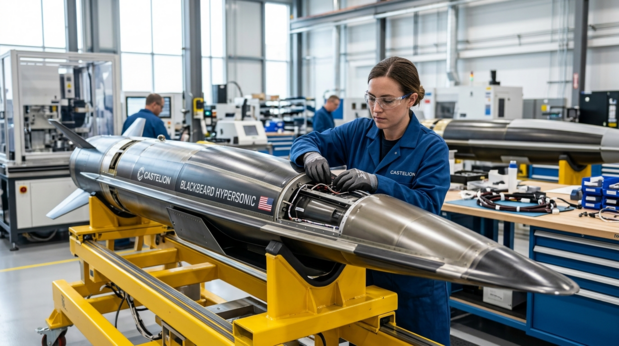
The U.S. Navy has awarded a $200 million contract to defense startup Castelion for the production of its Blackbeard hypersonic missile. This significant investment underscores the Navy’s commitment to enhancing national security through advanced defense technologies while also fostering growth in American industry and skilled labor.
The Blackbeard missile is designed as an air-launched hypersonic weapon, aimed at providing carrier-based strike fighters with enhanced capabilities. This contract not only represents a step forward in military technology but also reflects the Navy’s ongoing efforts to modernize its arsenal in response to evolving global threats. The decision to partner with a startup like Castelion indicates a willingness to leverage innovative approaches within the defense sector, which can often lead to more efficient and cost-effective solutions.
Castelion, as a relatively new player in the defense industry, is poised to make a significant impact on local economies through this contract. The production of the Blackbeard missile will likely create jobs and stimulate investment in the surrounding communities. Skilled workers will be needed for various aspects of production, from engineering to assembly, thereby supporting the workforce and contributing to the local economy.
Moreover, the contract aligns with broader trends in the defense industry, where there is an increasing emphasis on rapid technological development and production capabilities. As the U.S. military seeks to maintain a competitive edge, investments in hypersonic technology like the Blackbeard missile could enhance operational readiness and effectiveness in future conflicts. This focus on modernization is essential for ensuring that American forces are equipped to respond to emerging threats.
While challenges such as production timelines and budget management will need to be navigated, the awarding of this contract reflects a proactive approach to defense spending. The $200 million investment is expected to support the production of 444 Blackbeard missiles, indicating a substantial commitment to advancing this technology. This level of investment not only reinforces national security but also demonstrates confidence in the capabilities of American defense contractors.
In addition to bolstering military readiness, the contract signifies a collaborative effort between the Navy and the private sector. Such partnerships can lead to innovation and efficiency, as defense startups like Castelion bring fresh ideas and agile methodologies to the table. This collaboration is essential in an era where technological advancements occur rapidly, and traditional defense procurement processes may struggle to keep pace.
Ultimately, the Blackbeard missile contract is more than just a financial transaction; it represents a multifaceted investment in the future of American defense capabilities. As the Navy continues to modernize its forces, the collaboration with companies like Castelion could pave the way for further advancements in military technology, enhancing both national security and economic resilience.
In conclusion, the $200 million contract awarded to Castelion for the Blackbeard hypersonic missile production not only strengthens the U.S. Navy’s technological arsenal but also supports American industry and skilled labor. As production ramps up, the implications for local economies, job creation, and national security will be significant, marking an important step in the ongoing evolution of defense capabilities.