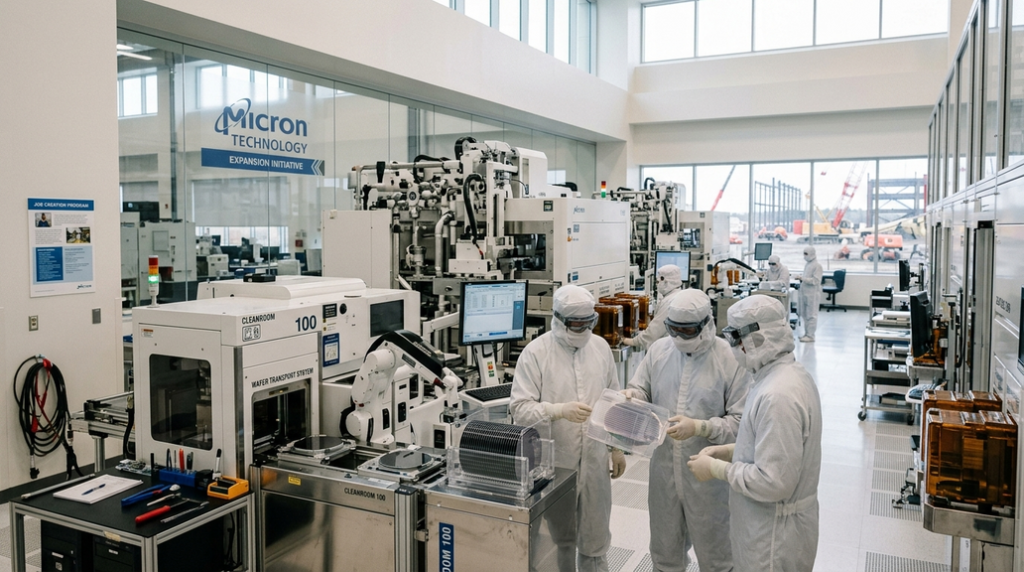
Micron Technology announced plans to increase its total U.S. chip production investment to $250 billion through 2035, a $50 billion increase over its previous commitment. The expanded investment will grow domestic manufacturing capabilities for dynamic random-access memory (DRAM) and high-bandwidth memory (HBM), driven primarily by artificial intelligence demand.
The company’s strategy includes constructing new fabrication plants and expanding existing facilities across several states. Notably, Micron will build a second fabrication plant in Boise, Idaho, costing approximately $30 billion to specialize in HBM production. The company will also expand its existing chip plant in Manassas, Virginia, and develop up to four new fabs in New York. Construction is already underway for two new fabs in Boise, and concrete has recently been poured for the New York facility, which is expected to be the largest semiconductor manufacturing site in U.S. history.
These enhancements aim to produce 40% of Micron’s DRAM in the U.S., bringing full-spectrum memory chip production back to American soil and reshoring critical technology currently centered in Taiwan. DRAM production in Idaho is scheduled to commence in 2027.
Beyond expanding manufacturing capacity, Micron has committed an additional $3 billion to strengthen the U.S. semiconductor supply chain. This initiative includes a $500 million investment in GlobalWafers’ silicon wafer production facility in Sherman, Texas. Strengthening domestic raw materials and components production is expected to increase the resilience and security of semiconductor supply chains.
The combined projects in Idaho, New York, and Virginia are projected to create approximately 90,000 direct and indirect jobs, contributing to local economies and workforce demand in high-tech manufacturing sectors.
Micron’s announcement follows the company securing $6.2 billion in federal funding through the CHIPS and Science Act, with an additional $275 million in incremental grants supporting the expanded investment. The news was well received by investors, with Micron shares rising nearly 5% following the announcement.
This sizable investment marks another significant step toward enhancing the United States’ domestic semiconductor production capacity. It reflects the growing emphasis on securing critical technology supply chains amid global competition and increasing demand for advanced memory chips that power artificial intelligence and other high-performance computing applications.