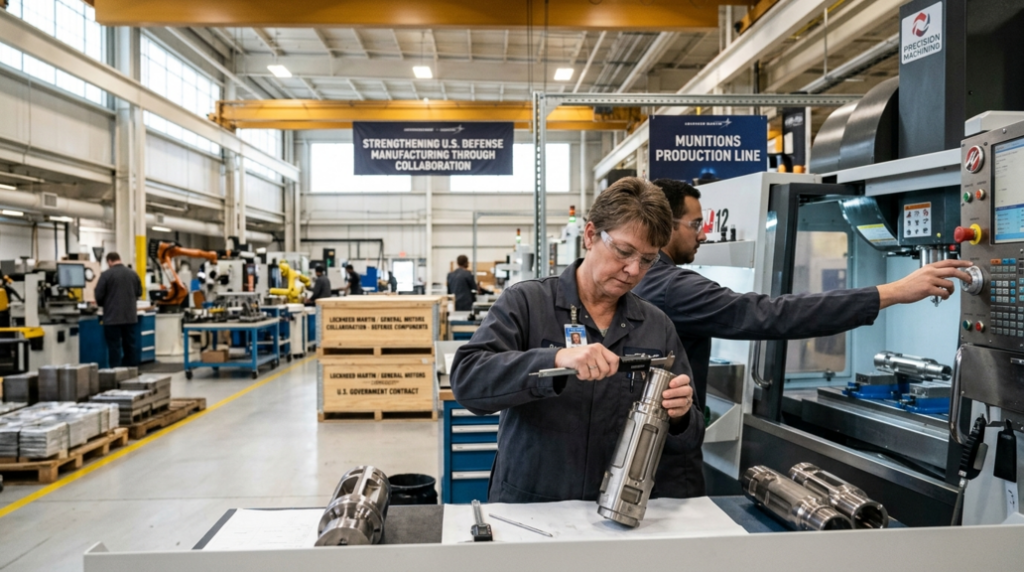
General Motors (GM) is reportedly engaged in talks with defense contractor Lockheed Martin to supply commonly used weapons parts that could assist in increasing munitions production. While details remain under discussion and no agreement has been finalized, the potential collaboration reflects a growing trend of industrial companies expanding their roles in national defense supply chains.
The renewed interest in scaling munitions production comes amid heightened demand resulting from ongoing geopolitical conflicts, including the war in Ukraine and tensions in the Middle East. U.S. Department of Defense officials have highlighted the need to replenish and expand stockpiles that have been drawn down in recent years. Lockheed Martin, a leading supplier of missiles, interceptors, and strike weapons, has been actively seeking ways to ease production constraints caused by supply chain bottlenecks.
GM, with its extensive high-volume manufacturing expertise and deeply established supply chains, is seen as a logical partner to address these challenges and help speed up assembly lines and meet escalating demand. Frank St. John, Lockheed’s COO, has noted that the company is investing heavily with a multi-billion-dollar capital commitment across its facilities to boost capacity.
For GM, which has been expanding its defense activities through its GM Defense subsidiary in recent years, this potential partnership offers a way to utilize idle manufacturing capacity amid softer vehicle sales. It also creates a new revenue stream aligned with national priorities as industrial and defense sectors increasingly overlap. The automaker has already engaged with federal officials, including during the Trump administration, to explore expanded roles supplying the military.
However, industry analysts caution that the overlap between automotive manufacturing and defense components is limited. The transition from auto parts to weapons components involves technical and regulatory differences that could moderate the scale of impact. Still, GM’s reputation for supply chain reliability and volume production may provide Lockheed and the Pentagon with a valuable operational advantage.
The talks indicate a strategic pivot in U.S. defense industrial policy toward engaging nontraditional suppliers to accelerate production timelines and diversify sources amid ongoing global military demand. Such collaborations underscore the broader effort to maintain American manufacturing strength and supply chain resilience in defense-critical sectors.
If finalized, the arrangement could mark another step in the evolving relationship between commercial manufacturers and defense contractors, with a focus on meeting urgent equipment needs while sustaining domestic production capacity.